Swimlane diagram maker
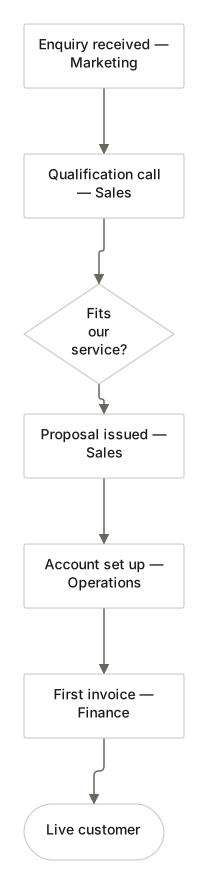
Swimlanes answer the question a plain flowchart dodges: not just what happens, but who it happens to. The handoffs between lanes are where processes usually go wrong.
No account. Saved in this browser until you export it.
The pieces
What goes on the canvas
- Step
- Work done inside a lane
- Decision
- A branch, usually handing off
- Handoff
- Work passing to another lane
- Start / End
- Where the process opens or closes
Building one
From blank canvas to finished diagram
- 1Name one lane per team or role. Four is usually plenty — Customer, Sales, Operations, Finance is a common start.
- 2Place each step in the lane that owns it. Dragging a step into a lane reassigns it.
- 3Connect steps across lanes. Every crossing line is a handoff worth examining.
- 4Count the crossings. A process that crosses lanes eight times is telling you something.
Where it helps
Good uses
Order to invoice
Customer places an order, sales confirms, operations ships, finance invoices.
Approval chains
Shows how long a request waits in a lane that is not doing anything.
Cross-team incidents
Who picks it up, who escalates, who tells the customer.
Service design
Front-stage and back-stage as separate lanes.
Questions
Asked often
- Horizontal or vertical lanes?
- Horizontal suits processes that run long. Vertical suits ones with many parallel steps. Both are available.
- What happens if I move a lane?
- Its steps move with it. A lane owns its contents, which is the whole point of a lane.
- How many lanes is too many?
- When the diagram no longer fits one screen, the process probably spans more than one diagram.
- Is anything uploaded?
- No. The diagram stays in this browser until you export it.
Show the handoffs
Nothing to sign up for. The diagram stays on this device.